

How to Tell If Coffee Beans Are Fresh
Table of Contents
- Why Freshness Matters in Coffee Beans
- Check the Roast Date vs Expiration Date
- Examine Bean Appearance and Oil Residue
- Perform the Coffee Bloom Test
- Assess Aroma and Smell Profile
- How to Store Coffee Beans for Maximum Freshness
- Taste Profile Indicators of Stale Coffee
- Conclusion
- Frequently Asked Questions
Last Updated: September 4, 2026
Why Freshness Matters in Coffee Beans
Fresh coffee beans deliver complexity and aroma; stale ones taste hollow and papery. Freshly roasted beans contain volatile compounds and carbon dioxide that create the aroma, acidity, and flavor notes you're paying for. Once those escape, no brewing method can salvage the cup.
Within days of roasting, beans begin degassing and releasing carbon dioxide. After a few weeks, oxidation breaks down the oils that carry flavor. Understanding freshness matters for anyone serious about coffee.
Telling fresh beans from stale ones is straightforward: you need to know what signals matter.
Check the Roast Date vs Expiration Date
The roast date is your most reliable freshness indicator, telling you exactly when the beans reached peak flavor.
Look for the roast date on the bag. Ideally it should be within two weeks for whole beans (sca.coffee). Beans roasted more than four weeks ago have lost much of their volatile compounds.
Don't confuse roast date with "best by" or "use by" dates, those are often arbitrary. If a bag doesn't display a roast date, that's a red flag.
Examine Bean Appearance and Oil Residue
Fresh beans are glossy with visible oil residue on the surface. This oil signals freshness and carries flavor compounds.
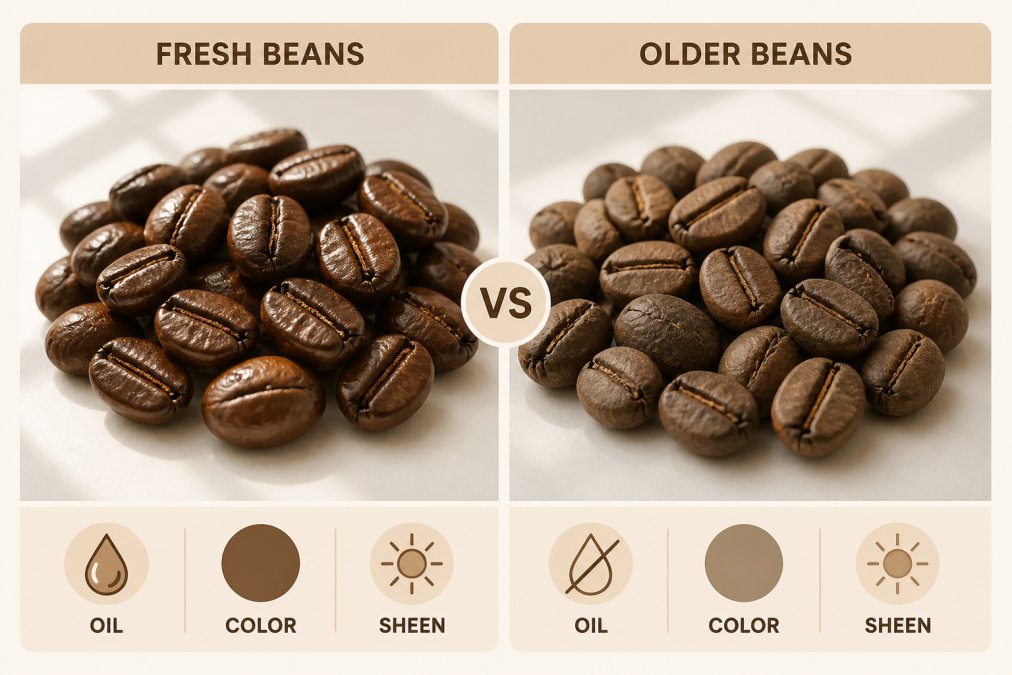
Why Oils Appear and Disappear
During roasting, heat forces oils to the bean's surface. In the first two weeks after roasting, the bean remains oily and active. As it ages:
- Oxidation consumes the oils. Oxygen in the air reacts with the surface oils, breaking them down into compounds that taste stale or rancid. This is a chemical process, not just evaporation.
- The bean loses moisture. As water content drops, the bean's surface becomes drier and the remaining oils spread thinner, making the bean appear matte.
Stale beans look dry and chalky because surface oil has oxidized. Fresh beans gleam; old beans don't.
How Roast Level Affects Oil Visibility
Dark roasts show more visible oil than light roasts because longer roasting brings more oils to the surface. Oil visibility is roast-dependent, so don't compare across roast levels. Even light roast beans should show some sheen if fresh (within 10-14 days). Flat, dull appearance across any roast level signals staleness.
Bean Density and Freshness Aging
Denser beans (higher-altitude farms) age slower than less dense beans due to tighter cellular structure. Origin affects appearance, so a fresh Ethiopian and fresh Brazilian bean from the same roast date may look slightly different.
Perform the Coffee Bloom Test
The bloom test reveals freshness: when you pour hot water over ground coffee, fresh beans release carbon dioxide rapidly, causing visible expansion. Stale beans barely bloom.
The Chemistry of Bloom and Degassing
Fresh beans contain 5-8% CO₂ by weight immediately after roasting; this drops to 1-2% by week four (peer-reviewed research). A vigorous bloom indicates significant CO₂ and volatile flavor compounds. A weak bloom means most CO₂ has escaped and volatile compounds have oxidized.
How to Perform the Test Correctly
Grind 15-20 grams of coffee and pour hot water (around 200°F) to wet the grounds. Fresh beans puff up and bubble within 2-3 seconds; stale beans show minimal movement. Wait for the bloom to subside before continuing to brew.
Critical Variables That Affect Bloom Intensity
Bloom is a useful test, but it's not foolproof. Several factors can make a bloom appear weaker than it should, or stronger than freshness alone would explain:
Grind size: Finer grounds expose more surface area to water, which accelerates CO₂ release and creates a more dramatic bloom. Coarser grounds bloom less visibly, even if the beans are fresh. If you're using a French press grind (coarse), expect a gentler bloom than with espresso-fine grounds.
Water temperature: Water hotter than 205°F will trigger a more aggressive bloom because heat accelerates gas release (peer-reviewed research). Water cooler than 195°F may produce a weak bloom even with fresh beans. Use water between 195-205°F for a reliable test.
Roast level: Dark roasts bloom more dramatically than light roasts due to more fragmented cell structures. Beans roasted on the same day may bloom differently depending on roast level.
Time since roasting: The bloom is most dramatic in the first 5-7 days after roasting. By day 14, even fresh beans show a noticeably gentler bloom. By day 28, the bloom is often barely perceptible. This is why roast date matters more than bloom alone.
What Bloom Cannot Tell You
A weak bloom suggests staleness but doesn't prove it. Combine bloom with roast date, aroma, and visual inspection for a complete freshness picture.
Assess Aroma and Smell Profile
Fresh coffee has a complex, vibrant aroma that varies by origin and roast. Light roasts smell bright and fruity; dark roasts smell deeper with chocolate or caramel notes. Stale coffee smells flat and muted.
When you open a bag, smell the beans before grinding. Fresh beans should hit you with aroma immediately. Whole beans release aroma more slowly than ground coffee, so grind just before brewing.
How to Store Coffee Beans for Maximum Freshness
Storage conditions determine how quickly beans deteriorate. The enemies are heat, light, oxygen, and moisture. Use an airtight container, a one-way valve is ideal because it lets carbon dioxide escape without letting oxygen in.
Keep beans in a cool, dark place away from heat and light. Don't refrigerate or freeze unless storing for several months. Expect peak flavor for about two weeks after roasting. Order smaller quantities frequently for maximum freshness.
Taste Profile Indicators of Stale Coffee
Fresh coffee has balance and complexity; stale coffee tastes hollow and papery. Papery taste is the most common indicator, caused by oxidation breaking down compounds that create sweetness.
Body diminishes: fresh coffee feels full and rich; stale coffee feels thin and watery. Acidity also changes, fresh coffee has bright, pleasant acidity; stale coffee's acidity becomes harsh or disappears.
Grind size affects how quickly you detect staleness. Espresso reveals stale beans immediately; pour-over and French press mask it slightly. But no brewing method can fix truly stale coffee.
Conclusion
Start with the roast date, check for oil and sheen, run the bloom test, and trust your nose. These simple checks give you complete information about freshness. When you order from Jos store, beans are roasted to order and shipped within days at their peak. Start with fresh beans, store them properly, and you'll immediately notice the difference in every cup.
Frequently Asked Questions
What is the coffee bloom test and how do I perform it?
The coffee bloom test reveals how fresh your beans are by observing CO2 release. Pour hot water (just off boil) over ground coffee and watch for vigorous bubbling and foam. Fresh beans bloom dramatically within seconds because they still contain carbon dioxide from the roasting process. Stale beans produce minimal or no bloom. This test works best with beans roasted within 2-4 weeks. Perform it in a clear cup or small vessel to clearly see the reaction.
How do I understand coffee roast date vs expiration date?
The roast date tells you when beans were roasted, not when they expire. Freshly roasted beans peak in flavor 5-14 days after roasting as CO2 degasses. They remain drinkable for 4-6 weeks but decline in quality after that. Expiration dates on bags often reflect packaging requirements rather than actual freshness. Always prioritize the roast date over an expiration date. Beans roasted within the past two weeks offer optimal aroma, acidity, and flavor notes.
What's the best way to store coffee beans for maximum freshness?
Store beans in an airtight container away from light, heat, and moisture. A sealed bag with a one-way valve works well if kept in a cool, dark cupboard. Avoid the refrigerator or freezer unless you plan long-term storage beyond six weeks. Whole beans stay fresher longer than ground coffee because grinding exposes more surface area to oxidation. Keep beans at room temperature (60-70°F ideally) and use them within 4-6 weeks of the roast date for peak flavor and volatile compound retention.
Can I still use coffee beans that are older than a few months?
Beans older than 2-3 months are drinkable but have lost peak flavor, aroma, and acidity. Stale coffee develops a papery, hollow taste as volatile compounds degrade and oxidation occurs. The body becomes thin and extraction becomes difficult. However, very old beans won't harm you. If you must use older stock, grind finer and use more grounds to compensate for reduced flavor intensity. For the best experience, we recommend using beans within 4-6 weeks of roasting.